


Last updated November 24, 2026
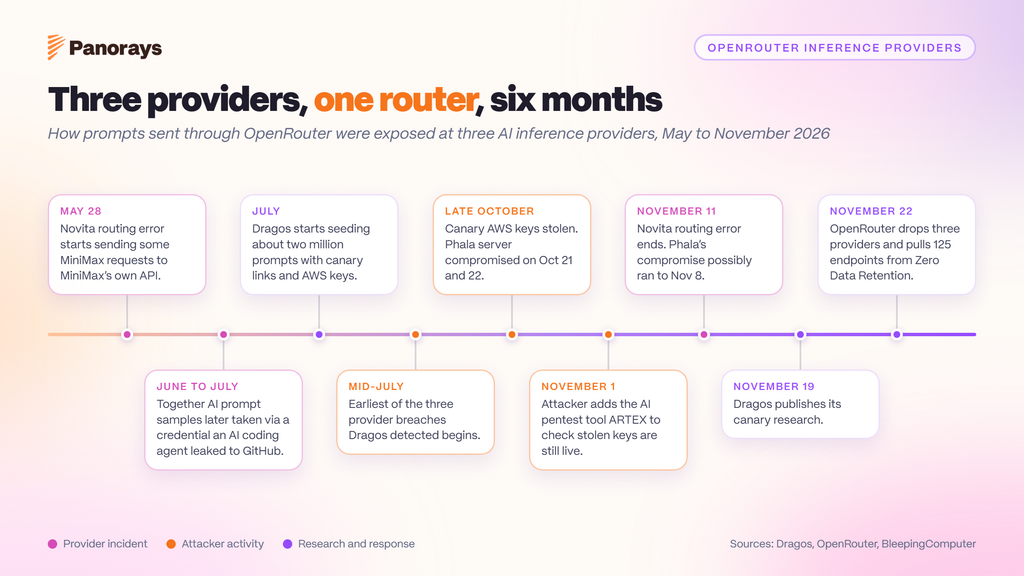
On November 22, 2026, OpenRouter, a widely used service that routes developers’ AI requests to dozens of model hosts, removed three inference providers from its platform and pulled 125 endpoints from its Zero Data Retention program. It acted on research from industrial security firm Dragos, which spent five months planting about two million booby-trapped prompts and watched some of them turn up in attackers’ hands, including fake AWS keys that were later used to probe cloud accounts.
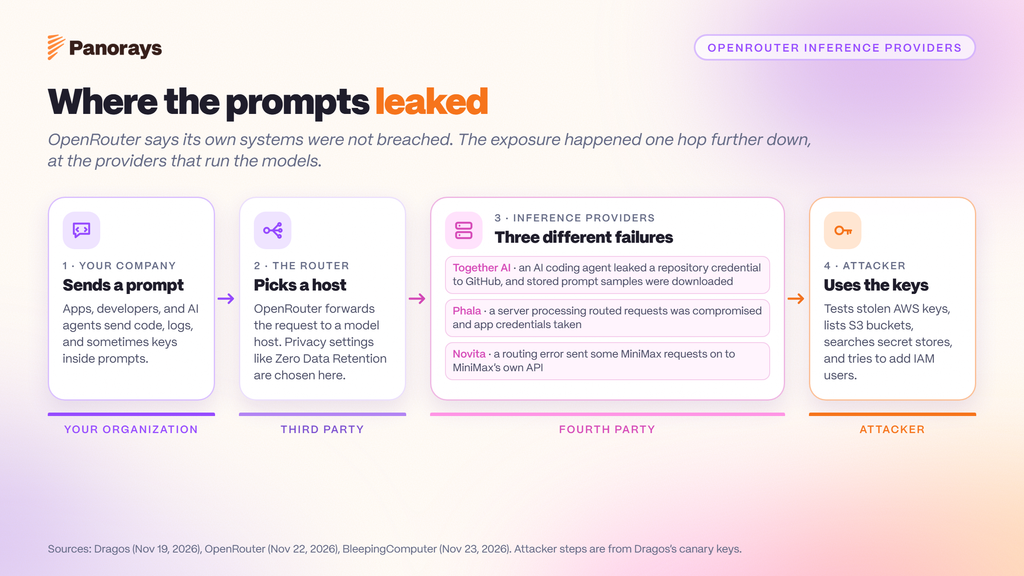
OpenRouter says its own systems were not breached, and the exposure happened one hop further down, at the companies that actually run the models. And for security and risk teams, that is the part worth sitting with, because a business that sends prompts through a router has two layers of vendors handling its data, and it usually has a contract with only one of them.
What happened in the OpenRouter prompt leak?
Dragos ran a canary test through AI routing services from July through November 2026. Each prompt carried a unique URL, a DNS name, and a real AWS key tied to an empty, fully logged account. When those canaries started getting used, Dragos had evidence that data from at least three AI providers was exposed. Its findings were published on November 19, and OpenRouter announced its response three days later.
According to BleepingComputer, the three removed providers were Together AI, Phala, and Novita, and each had a different problem.
| Provider | What happened, as disclosed | When |
| Together AI | An AI coding agent exposed a repository credential on GitHub, and an unauthorized party downloaded stored prompt samples involving MiniMax M3, GLM-5.2, and Kimi K2.6. | Prompt samples from June and July 2026 |
| Phala | An attacker compromised a server processing DeepSeek V4 Flash 0731 requests routed through OpenRouter and obtained application credentials from affected virtual machines. | October 21 to 22, 2026, and possibly up to November 8 |
| Novita | A routing misconfiguration forwarded some MiniMax requests, including those sent through OpenRouter, to MiniMax’s official API. | May 28 to November 11, 2026 |
| Atlas Cloud (not removed) | Withdrew its models from OpenRouter voluntarily, pending security testing, after a third-party security incident. | Not disclosed |
In its incident notice, OpenRouter says it off-boarded three providers, removed 125 endpoints from Zero Data Retention eligibility (some flagged by the researchers, others as a precaution), and notified all potentially affected customers. OpenRouter is also adapting the researchers’ testing so it can run the same checks on an ongoing basis.
What did the attackers do with the stolen data?
Fake AWS keys give the clearest picture. The largest of the three breaches, according to Dragos, involved a couple hundred of its keys, stolen in a few short windows in late October. Each key had been sent in exactly one request to one provider, so every use pointed back to where it leaked.
First, the attackers tested each key to see whether it was live, sometimes within hours. Then they listed S3 buckets and searched AWS Secrets Manager and Parameter Store, and they tried to enable hosted models in AWS Bedrock, create Bedrock API keys, and add their own IAM users to keep access. In total, the bait accounts logged tens of thousands of AWS API calls. On November 1, the same attacker added an AI-driven penetration testing framework called ARTEX to confirm that keys were still live.
In the other two breaches, Dragos reports, some of the stolen requests had been marked for Zero Data Retention. Its blunt read is that a privacy flag binds only the first hop. A setting chosen at the router is a request to the provider behind it, and it holds only as well as that provider keeps it.
Was OpenRouter breached?
No, according to OpenRouter. OpenRouter says the findings did not show any breach or unauthorized access of OpenRouter itself, and BleepingComputer reports the leak happened at the provider level. Dragos ran its tests through OpenRouter because it sits in front of many providers at once, which made it a practical place to measure what happens downstream.
And that distinction matters for how teams respond. So rotating your OpenRouter API key will not undo the exposure. What leaked was whatever you put inside the prompts while they were being processed by the affected providers.
Was a third party involved?
The whole incident is a third-party story, and most of it sits one layer deeper than vendor inventories usually reach. When a developer calls a model through a router, the router is the third party. The company hosting the model, often chosen automatically for price or speed, is a fourth party. Your organization may have a contract, a security review, and a data processing agreement with the router, and nothing at all with the host that actually reads the prompt.
There is a second layer of risk in what goes into the prompts. Coding assistants and AI agents routinely paste configuration files, logs, and code into requests, and those often carry API keys, database credentials, and cloud secrets. One of the three incidents started with exactly that pattern on the provider’s side, when an AI coding agent leaked a credential to GitHub.
The Panorays 2026 CISO Survey found that half of reported third-party cyber incidents originated beyond direct vendors, through fourth parties, Nth parties, and other external relationships. Only 15% of CISOs said they have full visibility into those relationships. AI routing adds a fast-moving layer to that blind spot, and it often arrives through a developer’s credit card rather than through procurement, a pattern covered in our piece on shadow AI and third-party risk.
What should security and risk teams do now?
Start by finding out whether your teams or your vendors send traffic through OpenRouter or the affected providers, then treat anything sensitive that went into those prompts as exposed. Five steps cover most of the exposure:
- Find the usage. Check expense reports, API key inventories, egress logs, and code repositories for OpenRouter, Together AI, Phala, Novita, and Atlas Cloud. Developer tools and internal agents are the likely places.
- Rotate what may have been in a prompt. The providers are advising potentially affected users to rotate any secrets that may have been exposed in leaked requests. Cloud keys, database credentials, and tokens pasted into prompts since late May belong on that list.
- Hunt in your cloud logs. Look in AWS CloudTrail for unexpected key validation calls, S3 bucket listings, Secrets Manager and Parameter Store reads, new Bedrock API keys, and new IAM users. Dragos names the user agents artex-agent and artex-judge-r121 as worth an alert.
- Ask your vendors direct questions. Ask whether they use AI routers or third-party inference hosts, which providers sit behind them, and whether customer data or credentials can reach those prompts. Ask whether they received an OpenRouter notification and what they rotated. Our list of AI vendor risk assessment questions is a useful starting point.
- Put the fourth party in the contract. Require vendors to name the model hosts that process your data, to pass data retention terms down to them, and to notify you within a set window when one of them has an incident. Then add a leaking AI provider as a scenario in your third-party incident response plan.
What should engineering teams change?
Keep secrets out of prompts in the first place. Turn on secret filtering in coding assistants and agent frameworks, strip environment files from context, and give agents short-lived, narrowly scoped credentials. Where a router is used, pin the upstream providers instead of letting the router pick, and confirm that privacy settings change where requests actually go. It also helps to do what Dragos did on a small scale, seeding your own canary credential into AI traffic and treating any use of it as an incident.
What does the OpenRouter incident reveal about third-party risk?
AI services are being assembled the way the rest of the software supply chain was, out of layers that each depend on someone else. A router promised a privacy setting, and three separate failures underneath it- one stolen credential, one compromised server, and one misrouted request stream- showed how little that promise controls on its own. A similar lesson ran through recent AI supply chain incidents like the OpenAI and Mixpanel data exposure.
The practical response is to know which AI services your organization and your vendors depend on, including the hosts behind them, and to keep asking after the first answer. Teams that map those dependencies can act on an incident like this in a day. Those that cannot will find out from a provider’s notice, or from their own cloud bill.
To see how continuous monitoring keeps track of the vendors and fourth parties your business depends on, book a demo.
OpenRouter Prompt Leak FAQs
What happened at OpenRouter’s inference providers?
Between July and November 2026, Dragos sent about two million canary prompts through AI routing services and found evidence that data from at least three AI providers was exposed. On November 22, OpenRouter removed Together AI, Phala, and Novita, pulled 125 endpoints from Zero Data Retention eligibility, and notified potentially affected customers. Atlas Cloud withdrew voluntarily pending security testing.
Was OpenRouter itself hacked?
OpenRouter says no. It states that the findings did not show any breach or unauthorized access of OpenRouter, and the exposure happened at the inference providers that host the models. Prompts sent through OpenRouter to those providers could still have been exposed, so the risk to customers depends on what their prompts contained.
What data was exposed in the OpenRouter incident?
The exposed data was prompt content processed by the affected providers, along with anything inside it, such as API keys, cloud credentials, and links. Dragos’s planted AWS keys were stolen and used to probe cloud accounts, and Phala reports that application credentials were taken from affected virtual machines. Some stolen requests had been marked for Zero Data Retention.
Does Zero Data Retention protect my prompts?
Zero Data Retention is a policy commitment, and this incident shows its limits. Some ZDR-flagged requests were stolen anyway, according to Dragos, which notes that a privacy flag binds only the first hop. A retention promise cannot stop a provider’s server from being compromised while it processes your request, so keep secrets out of prompts regardless of the setting.
What should I ask vendors that use AI routers or model hosts?
Ask whether they use AI routers such as OpenRouter or third-party inference hosts, and which providers process your data. Ask whether customer data or credentials can reach their prompts, whether they were notified about this incident, and what they rotated. Then ask how quickly they would tell you if a model host handling your data had a breach.
