


On November 16, 2026, visitors to Zoom, the BBC, CNN, Salesforce, and GitLab were exposed to malicious code designed to steal their payment card details. The attack came through a shared vendor, Optimizely, a platform widely used to test and personalize websites.
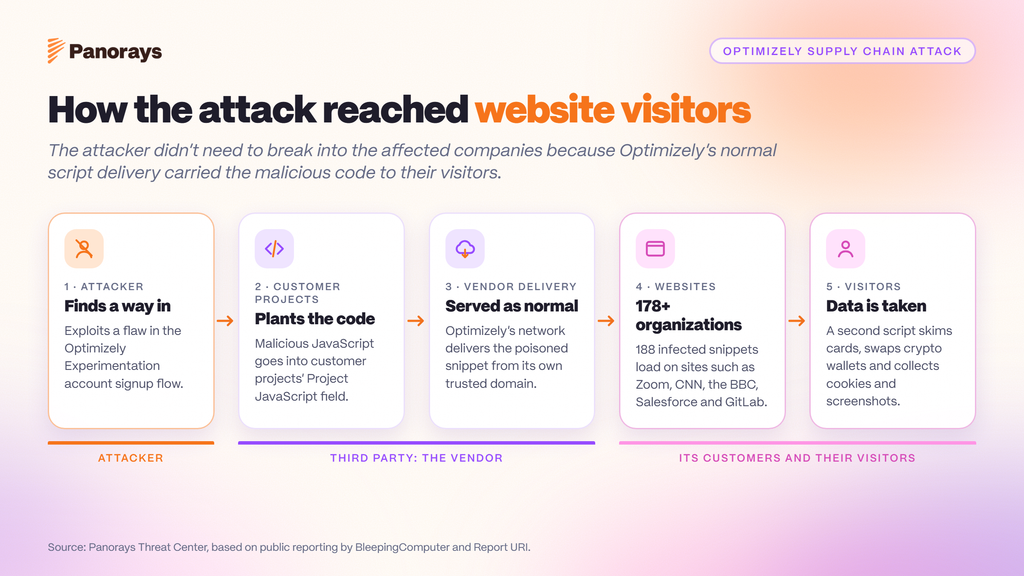
By exploiting a vulnerability in Optimizely’s Experimentation product, an attacker injected malicious JavaScript into customer projects. Optimizely’s own servers then delivered the code to visitors across 178 organizations. Much of the malicious code was removed the same day. But for 178 organizations, the attack began with a vendor they already knew and trusted.
Last updated November 17, 2026.
What exactly happened in the Optimizely supply chain attack?
An unauthorized party exploited a vulnerability in the account signup flow of Optimizely Experimentation and used it to add malicious JavaScript to some customer projects. Optimizely’s content delivery network then served that code, inside the normal Optimizely snippet, to everyone who visited the affected websites, so the Optimizely hack never needed to touch a customer’s servers. Optimizely says it has fixed the flaw, removed the injected code, revoked sessions and tokens, and notified affected customers.
Security researcher Scott Helme of Report URI found the attack while checking 1,611 Optimizely snippets, and Report URI’s analysis gives the clearest timeline so far.
| Date and time (UTC) | Event |
|---|---|
| November 13 to 16 | An earlier wave of the same campaign reaches sites through scripts from other web services |
| November 16, 04:21 | First malicious injection seen in an Optimizely snippet, on the BBC’s project |
| November 16, during the day | Report URI finds 188 infected snippets belonging to 178 organizations |
| November 16 | Optimizely identifies the exploitation, fixes the flaw, and starts removing the code |
| November 16, 21:52 | One infected snippet remains, down from 188 |
| November 16 to 17 | Salesforce confirms it has disabled Optimizely scripts while it investigates |
What did the malicious script steal, and who is affected?
Visitors to the affected websites on November 16 carry the risk, not the companies’ internal systems. In this Optimizely malware, a small loader pulled in a second script that, according to BleepingComputer’s report, could swap cryptocurrency wallet addresses for the attacker’s own, skim card numbers, expiry dates, and security codes from payment forms, and collect cookies, page addresses, and screenshots. On iPhones and iPads, it tried to load two exploit kits, which Helme identified as Coruna and DarkSword.
BleepingComputer confirmed through public scans that the script loaded, or tried to load, on sites including Zoom, KLM, GitLab, the BBC, CNN, Smartsheet, Salesforce, Fox News, and Air France. Report URI says the real number of affected organizations is likely higher than the 178 it counted, because its sweep covered only the snippets it could see.
So far the money trail is small. Helme traced about $7,040 to the attacker’s wallets by the evening of November 16, some of it from wallets that predate the attack. Card data is the larger loss, and nobody has measured it yet.
How did attackers get in?
Optimizely says attackers entered through a vulnerability in the signup flow of its Experimentation product. Report URI found the malicious code in the optional Project JavaScript field, a place where customers add their own code to the snippet. Everything else in each file was untouched, so the poisoned snippet still came from Optimizely’s domain with Optimizely’s certificate, which is why browsers trusted it.
But neither Optimizely nor Report URI has explained how the signup flaw gave the attacker write access to other customers’ projects, and no group has claimed the attack. Report URI also noted an earlier wave of the same campaign from November 13 to 16 through scripts from other web services, so Optimizely was not the only script provider the campaign reached.
Was a third party involved?
Yes. This Optimizely breach is a third-party incident by definition: for every affected website, Optimizely is a vendor whose code runs on its pages. For the people who visit those sites, it is a party they have never heard of. Nothing reported so far points to a break-in at the companies named. They loaded a vendor’s script, as they do every day, and the vendor delivered the attacker’s code with it.
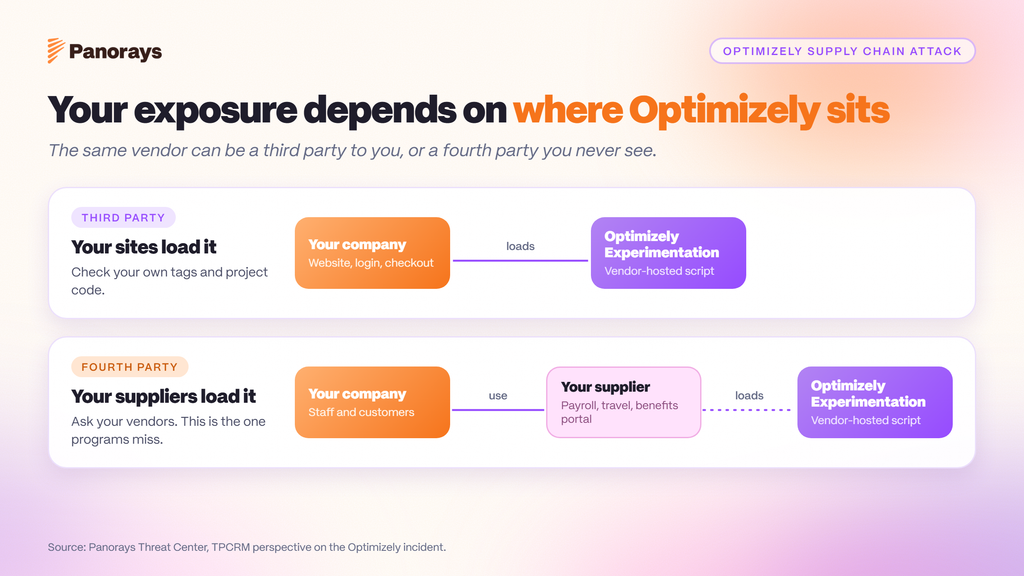
Panorays research on the incident describes the dependency plainly. Organizations load vendor-hosted JavaScript from Optimizely directly into customer-facing pages to run experiments, so a compromise of the vendor’s infrastructure lets an attacker change what runs in every visitor’s browser without touching the customer’s own systems. Where Optimizely sits for you decides your exposure: it is a third party if your sites use it, and a fourth party if a supplier’s sites do and your customers or staff use them.
That second case is the one many risk programs overlook. Your payment page may not load Optimizely, but the portal of your benefits provider, travel agency, or payroll vendor might. Panorays’ 2026 CISO Survey found that half of reported third-party cyber incidents originated beyond direct vendors, through fourth parties, nth parties, and other external relationships. The Optimizely attack shows how quickly a compromise at one shared supplier can reach organizations far beyond its immediate customers.
Third-party cyber risk management is how a team gets ahead of this. Mapping which vendors run code on your sites, and which digital suppliers your people depend on, turns a scramble into a short list of calls. Scoring each relationship by the access and data it touches tells you which of those calls to make first.
What should security and risk teams do now?
Treat this as two inventories, your own websites and your suppliers’, then close the gaps the attack used. The first pass is a narrow question: where does Optimizely’s script run, and was anything entered on those pages on November 16? The steps below follow Report URI’s guidance and the remediation Optimizely and Salesforce described.
- Check your own sites. Search your pages and tag manager for the Optimizely snippet, then review each project’s Project JavaScript and experiment code for anything you did not write. Rotate the credentials of everyone with access to your Optimizely account.
- Decide what November 16 means for your customers. If card data was entered on an affected page that day, treat it as possibly exposed and talk to your payment provider about notification. Rotate any secrets stored in cookies that scripts can read.
- Ask your suppliers the same questions. Request a short answer from vendors whose portals your staff or customers use: do your public sites load Optimizely Experimentation, did you confirm the injected code was removed or disable the tag, and did you revoke the related tokens?
- Tighten what third-party scripts are allowed to do. Report URI found that a Content Security Policy restricting where scripts can send data blocked the payload on some affected sites, while permissive settings such as unsafe-eval let it through.
- Add client-side scripts to your vendor reviews. Treat every tag on a page that handles logins or payments as a vendor with access, and include it in your third-party incident response plan so the next one starts with a list, not a search.
What can organizations do next?
If you entered card details on a large website on November 16, monitor your statements and contact your card issuer about any unfamiliar charges. If you sent cryptocurrency that day, check that the address you paid matches the one you intended to use. iPhone and iPad users should also update their devices. Report URI recommends iOS 18.7.3 or later, or iOS 26.3 or later, to protect against the exploit kits used in this incident.
For organizations, the attack is a reminder to look beyond direct vendors and understand which third parties can introduce code into your digital properties. Read more about how Panorays approaches supply chain risk monitoring, or book a demo to see how Panorays helps teams assess supplier risk and keep track of changes across their supply chain.
Optimizely Supply Chain Attack FAQs
Was Optimizely hacked?
Optimizely says an unauthorized party exploited a vulnerability in the account signup flow of its Experimentation product and used it to add malicious JavaScript to some customer projects on November 16, 2026. The company says it has fixed the vulnerability, removed the injected code, revoked sessions and tokens, reset affected accounts, and notified the customers involved.
Which websites were affected by the Optimizely attack?
Report URI found malicious code in 188 Optimizely snippets belonging to 178 organizations. BleepingComputer confirmed the script loaded, or tried to load, on sites including Zoom, KLM, GitLab, the BBC, CNN, Smartsheet, Salesforce, Fox News, and Air France. Report URI says the true number is probably higher than the snippets it was able to check.
What did the malicious Optimizely script steal?
The script could skim payment card numbers, expiry dates, and security codes from web forms, replace cryptocurrency wallet addresses with the attacker’s, and collect cookies, page addresses, and screenshots. On iPhones and iPads, it tried to load the Coruna and DarkSword exploit kits. Report URI traced about $7,040 in cryptocurrency to the attacker’s wallets on November 16.
Am I affected if my website uses Optimizely?
Optimizely says it notified the customers whose projects were changed, so check for that notice first. Then review your Project JavaScript and experiment code for code you did not add, rotate Optimizely account credentials, and treat card details entered on affected pages on November 16 as possibly exposed. Sites with a strict Content Security Policy were better protected.
What should I ask vendors that use Optimizely?
Ask whether their public sites or portals load Optimizely Experimentation, whether they confirmed the injected code was removed or disabled the tag, whether they revoked tokens tied to their Optimizely account, and what your people entered there on November 16. Our guide to third-party risk covers keeping that list current.
