
What is the Register of Information (RoI) Under DORA?
The Register of Information (RoI) is a key requirement under the EU’s Digital Operational Resilience Act (DORA), designed to give regulators complete visibility into which technology providers financial firms rely on, what those providers do, and how critical they are. DORA strengthens operational resilience across the financial sector. It ensures organizations can prevent, withstand, and recover from disruptions, especially those caused by cyber incidents or failures in critical third-party Information and Technology (ICT) services.
The Register of Information supports the ICT third-party risk framework, helping financial entities maintain an organized, up-to-date inventory of their technology suppliers and the associated risks. It’s important to note that the Register of Information is not a one-time submission. It must be updated continuously as providers are added, services are reclassified as critical, contracts change, or dependency chains shift.
Teams often need to gather data from contracts, procurement, legal, IT, risk, and vendor systems. That information then has to be entered into regulator-defined templates, coded correctly, reconciled across entities, and validated before submission.
This is where many RoI initiatives slow down. Not because a team lacks understanding of DORA, but because consistently and at scale executing RoI is operationally complex.
How Does Panorays’ Register of Information Solution Make Compliance Easier?
Panorays’ Register of Information solution simplifies the process. It reduces manual work, improves data consistency, and supports RoI readiness from initial data collection through validation and submission.
Panorays provides an automated solution that prepares and submits DORA reports from a single platform. Instead of stitching together spreadsheets and conducting last-minute reviews, teams follow a guided process, validate early, and generate a submission-ready ZIP file that meets DORA technical requirements.
The features of Panorays DORA Register of Information solution include:
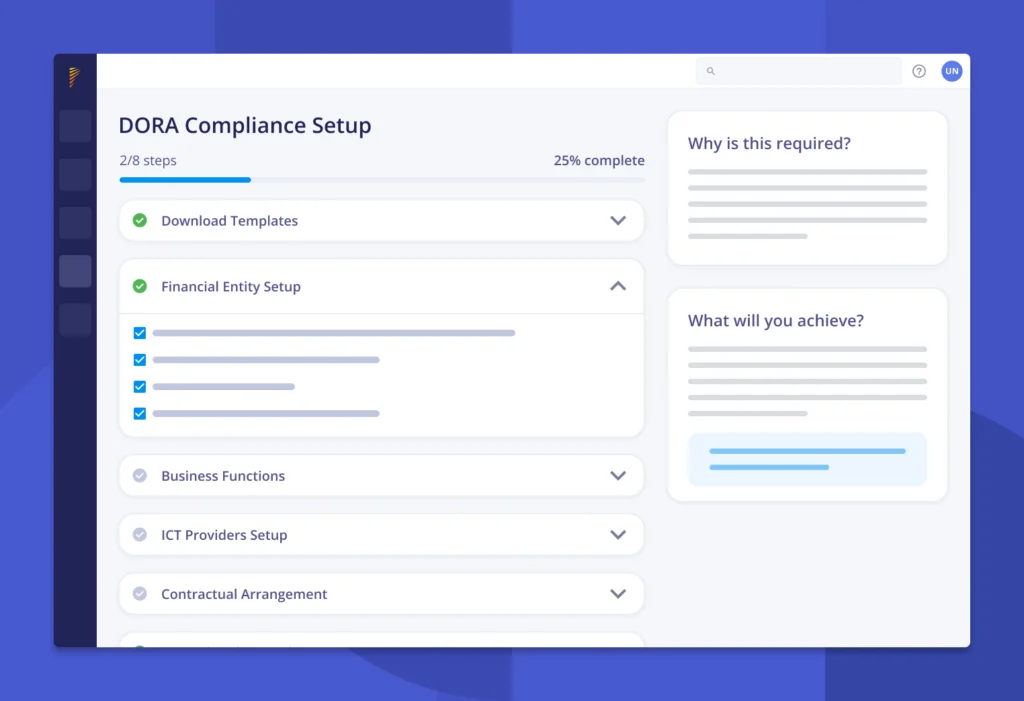
DORA RoI Checklist and Guidance
Panorays delivers a built-in DORA checklist that guides users through each step of the RoI process. Requirements are presented with regulator-aligned expectations, so teams understand what is expected to be done. This helps put everything in perspective and ensures no steps are missed.
DORA RoI Questionnaire Templates
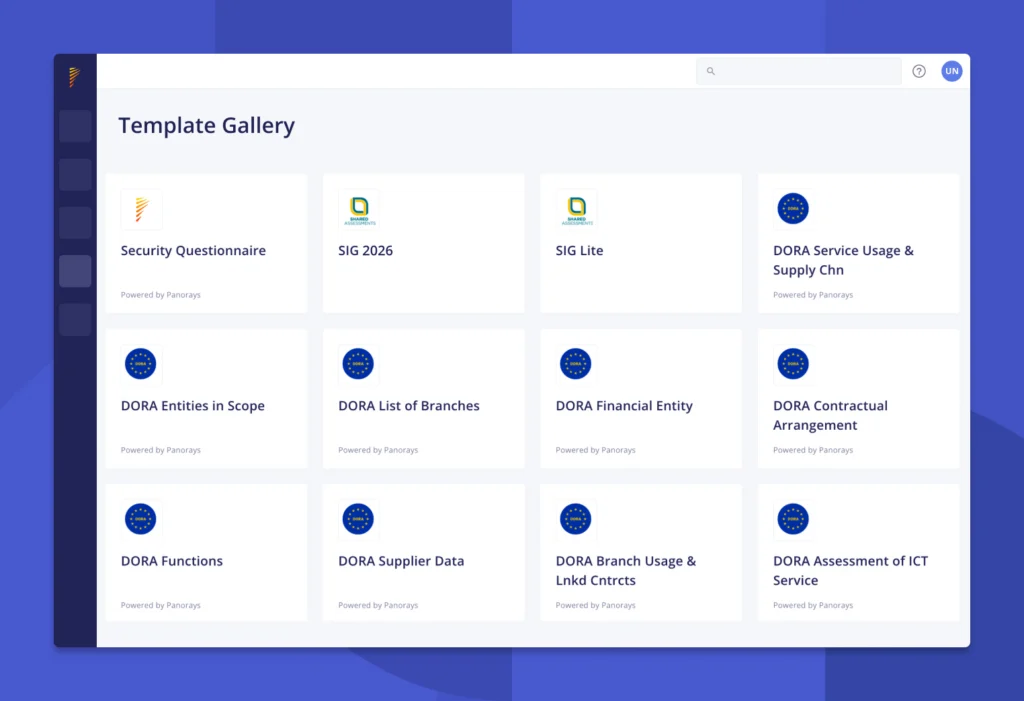
The platform offers a questionnaire library, with nine DORA-specific questionnaires mapped to RoI reporting requirements. These templates standardize how information is collected from ICT providers and internal stakeholders. As a result, data collection is simplified and automated for a faster, smoother process.
Pre-submission Review and Validation
Panorays consolidates all nine DORA questionnaires into a pre-submission preview report. Teams review answers at a category level, check for completeness, and spot inconsistencies before they block submissions. This typically shortens the review cycle, reducing the need for reconciliation later on.
Register of Information Simulation
The platform simulates the final Register of Information report, showing teams how their submission appears to regulators. Seeing the RoI in its expected format makes it easier to validate the structure and content earlier in the process. That visibility helps avoid surprises during the final export.
Ongoing Expert Support
Customers receive continuous professional support throughout the nine DORA questionnaires. This is particularly helpful when uncommon scenarios arise, which is often the case with complex ICT arrangements. With expert guidance available, teams spend less time clarifying requirements and more time advancing the process.
Early Format and Data Validation
Panorays automatically flags formatting issues in line with DORA specifications. This includes unsupported characters, file naming conventions, and country-specific legal identifiers. The result is problems that get resolved early, rather than during final submission reviews.
Cross-Questionnaire Error Handling
If any errors are detected, Panorays consolidates a detailed error report showing the exact location such as supplier name, file, questionnaire template, column, row, error type, description, and suggested correction, making it faster and easier to fix issues and move to submission.
Submission-Ready Output
Once validation is complete, Panorays generates a submission-ready ZIP file that meets DORA’s technical standards. The output includes the finalized regulatory file, ready for submission by the businesses. Teams can submit confidently, and avoid reformatting work after the fact.
Consolidated DORA and TPCRM Management
DORA requirements can be managed alongside third-party risk activities within the same platform. Teams can filter DORA questionnaires separately, without mixing regulatory reporting into general assessment workflows. This supports a single TPRM operating model while keeping DORA reporting distinct.
Important Tool Selection Considerations for DORA Compliance
Not all DORA tools support the Register of Information end-to-end. When evaluating RoI tools, organizations need to prioritize capabilities that reduce manual workload and submission risks, such as:
- Pre-built DORA templates: Tools with built-in DORA templates reduce the time and effort needed to get started. Dedicated DORA content helps teams follow the required structure from the outset and reduces interpretation risks.
- Continuous monitoring: DORA expects dynamic oversight instead of static third-party lists. Solutions must support ongoing updates, risk scoring, and prioritize alerts as provider risks change.
- Integration with GRC and contract systems: RoI data depends on contractual details and exit clauses. Integrations keep information accurate and avoid mismatches between the RoI and other internal systems.
- Export and audit-ready capabilities: Regulators assess RoI submissions for accuracy and consistency. Structured, exportable, regulator-aligned outputs are essential for thorough reviews, audits, and follow-up questions.
Tools that depend on manual data entry run into problems like missed errors, conflicting versions, and weak audit trails. Under DORA RoI, these gaps surface during reviews. A tool that only stores data, without validation or regulatory alignment, creates more risk than it reduces.
Why Panorays DORA Register of Information Tool is the Best Option on the Market
Many tools claim to support DORA compliance, but take different approaches to the Register of Information. Some platforms offer partial solutions, only focus on broad risk and compliance governance, or rely on manual processes. The RoI isn’t a nice-to-have under DORA; it is a regulated submission that demands accuracy, consistency, and regulator-ready output.
Panorays Compared to Other Approaches
| Tool | Panorays | 3rdRisk | Bitsight | OneTrust | Excel |
| DORA guided checklist/ step-by-step completion guidance | Strong | Moderate | Strong | Moderate | Not native |
| DORA dedicated questionnaire templates | Strong | Strong | Strong | Strong | Moderate |
| Consolidated pre-submission review | Strong | Moderate | Not native | Not native | Not native |
| Submission-ready output package (regulator-compliant ZIP) | Strong | Moderate | Moderate | Not native | Not native |
| Notes | DORA RoI submission accuracy and regulator-ready output | Integrated EU risk | Reliable external risk intelligence | Integrated TPRM and compliance workflows | Small-scale or temporary RoI tracking |
Final Thoughts
Panorays’ solution streamlines the process from start to finish. Teams use guided steps to complete RoI requirements, standardize data collection through nine DORA questionnaires, validate early through pre-submission previews, simulate the RoI output for regulator-aligned review, and generate a ZIP file built to DORA formatting standards.
Book a demo to see Panorays’ DORA Register of Information tool in action, and how its RoI simulation, pre-submission validation, and submission-ready ZIP output make it one of the best options available.